Why You Should Save Contact Form Submissions in Your Database

Most WordPress sites send form submissions by email and store nothing in the database. That works until it does not. A misconfigured mail server, a spam filter catching your notification email, or an inbox that nobody checked for three days, and that lead is gone with no record left anywhere on your site.
Saving form submissions to the WordPress database means every entry is stored the moment someone hits submit, before any email notification even fires. The lead is safe regardless of what happens with email. And once submissions are in the database, they become searchable, filterable, exportable, and analysable in ways that an inbox never can be.
This article covers why database storage matters, what it makes possible, and how to get it set up free with Form Vibes in one step.
Why Are Email Notifications Alone Not Enough?
Email notifications serve one purpose well, alerting you that a new submission arrived. For anything beyond that alert, email is the wrong tool for the job.
The problems are specific and common. Mail servers misconfigure silently, meaning submissions go out but never arrive anywhere. Spam filters treat notification emails as bulk mail and swallow them without warning. When your site receives dozens of enquiries a week, an inbox becomes an unstructured archive, finding a specific lead from three months ago means scrolling through hundreds of unrelated messages with no way to filter by form, date, or any field value.
Email also creates a team problem. Sharing submissions means forwarding emails manually. There is no way for two people to review the same list and mark what they have already handled. There is no way to add a note to a specific entry that stays with the record. And there is no view of how submission volume is changing over time, email tells you a submission arrived, not whether this week’s enquiries are more or fewer than last month’s.
None of these are edge cases. They are daily realities for any site running active forms.
What Are the Real Benefits of Saving Submissions to the Database?
Each of the following is a specific outcome, not a general principle.
Every lead is safe regardless of email delivery. Form submissions are written to the database at the moment of submission, before the email notification fires. If the email fails for any reason – server error, spam filter, full inbox, the entry is already stored and accessible from your WordPress dashboard. No submission is dependent on email infrastructure working correctly.
You can find any submission in seconds. A database record is searchable. Filter by the form it came from, the date it was submitted, or the value of any specific field. Finding every enquiry from last month where the service field equals “Web Design” takes one filter selection. Finding the same information in an email inbox is not realistically possible.
Your data becomes exportable and shareable. Submissions stored in a database can be downloaded as a CSV file and opened in Excel or Google Sheets. This makes client reporting, CRM imports, and team handoffs straightforward. Data locked inside an email client belongs to whoever owns that inbox, database storage makes it genuinely portable.
You can see how your forms are actually performing. Analytics charts showing daily, weekly, and monthly submission volume tell you whether a form is generating more or fewer leads over time, whether a recent campaign drove a measurable spike, and whether a form that used to perform well has gone quiet. None of this is visible from an inbox.
Your team can work on submissions together. A shared dashboard with role-based access means multiple people can review the same entries without email forwarding. Submission status marking shows who has been reviewed and who has not. Internal notes stay attached to specific entries. This is a workflow, email is not.
Stop relying on your inbox to keep leads safe. Use Form Vibes that stores every submission automatically, so you can filter, export, and analyse your form data whenever you need it.
Email Only vs Database Storage – A Direct Comparison
| Feature | Email Notifications Only | Database Storage (Form Vibes) |
|---|---|---|
| Submissions safe if email fails | No | Yes |
| Searchable by field value | No | Yes |
| Filterable by date range | No | Yes |
| Exportable to CSV | No | Yes |
| Viewable by multiple team members | No | Yes |
| Status marking and team workflow | No | Yes |
| Analytics and submission trends | No | Yes |
| Accessible without email client | No | Yes |
Tips: If you already collect form submissions, storing them in the database with Form Vibes makes it easier to manage entries with filtering, exports, analytics, and better organization – instead of relying only on email notifications.
Which Plugin Should You Use to Save Form Submissions?
Form Vibes captures form submissions from nine WordPress form plugins and stores them in your WordPress database automatically. Install it, activate it, and it begins capturing without any configuration inside your existing forms.
The supported plugins are: Contact Form 7, WPForms (Lite and Pro), Elementor Forms, Gravity Forms, Ninja Forms, Bricks Builder Form, Beaver Builder, WS Form, and Everest Forms.
The free version of Form Vibes covers everything, every submission captured at the moment it is submitted, a filterable submissions dashboard, date range filtering, CSV export, analytics charts, an Event Log, and a WordPress admin dashboard widget. No configuration is needed inside your existing forms and no form plugin needs to be replaced or changed.
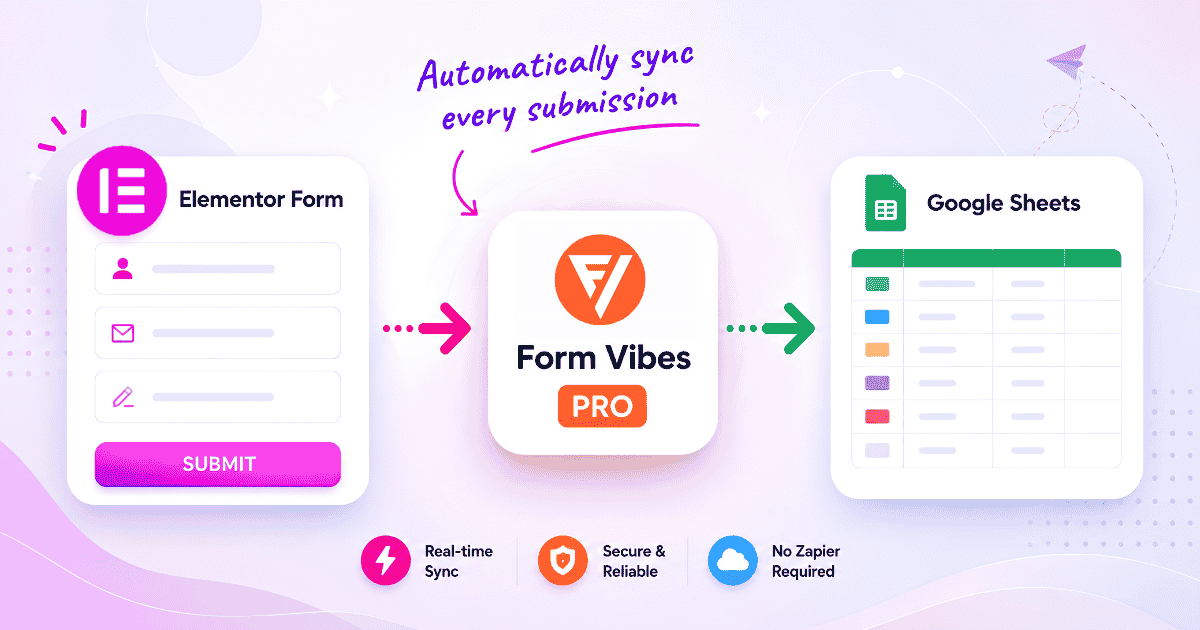
Form Vibes Pro adds advanced field-level filtering, submission status marking (Read, Unread, Spam), inline entry editing, submission notes for team annotations, Export Profiles for saved reusable exports, Google Sheets sync, and a Role Manager for controlling which team members can access which features.
To get started with your specific form plugin, see the setup guides for:
- Contact Form 7
- WPForms
- Elementor Forms
- Bricks Builder, and others.
Conclusion
Email notifications tell you a submission arrived. Database storage makes sure it is never lost and gives you something useful to do with it. Filtering, exporting, analysing trends, and managing a team review workflow all require submissions to live somewhere more structured than an inbox.
Form Vibes sets this up in one step, install it and every form on your site starts building a permanent, searchable, exportable record from the next submission forward.
Ready to set up Form Vibes with your specific form plugin? See the integration guide with Form plugins.

Stop Relying Only on Email Notifications
One missed email, one spam filter, one deleted notification, and that lead is gone forever. Form Vibes stores every submission the moment it arrives, so nothing depends on email working perfectly.
Frequently Asked Questions
Common questions about saving contact form submissions in database.
What happens to form submissions if email notifications fail?
If email notifications fail and no database storage plugin is active on your site, the submission is permanently lost. There is no fallback copy, no log, and no way to recover it. With Form Vibes active, submissions are written to the database the moment they are received, before the email notification fires, so the entry is always stored regardless of email delivery outcome.
Can I save submissions from multiple form plugins in one place?
Yes, with Form Vibes. It captures submissions from multiple WordPress form plugins simultaneously and displays all of them in a single unified dashboard. Switch between forms from any plugin using the form dropdown in the submissions table.
Can I export contact form submissions from Form Vibes?
Yes. When submissions are stored in the Form Vibes, you can export them into formats such as CSV files. This allows you to analyze data in tools like Excel or Google Sheets.
What is the easiest way to start saving form submissions in WordPress?
Install Form Vibes from the WordPress plugin directory – go to Plugins > Add New, search for “Form Vibes”, and activate it. Form Vibes begins capturing submissions from all supported form plugins on your site automatically from that point. No changes to your existing forms are needed and no configuration is required inside any form plugin.




Leave a Reply