How to Build and Configure a Bricks Builder Form
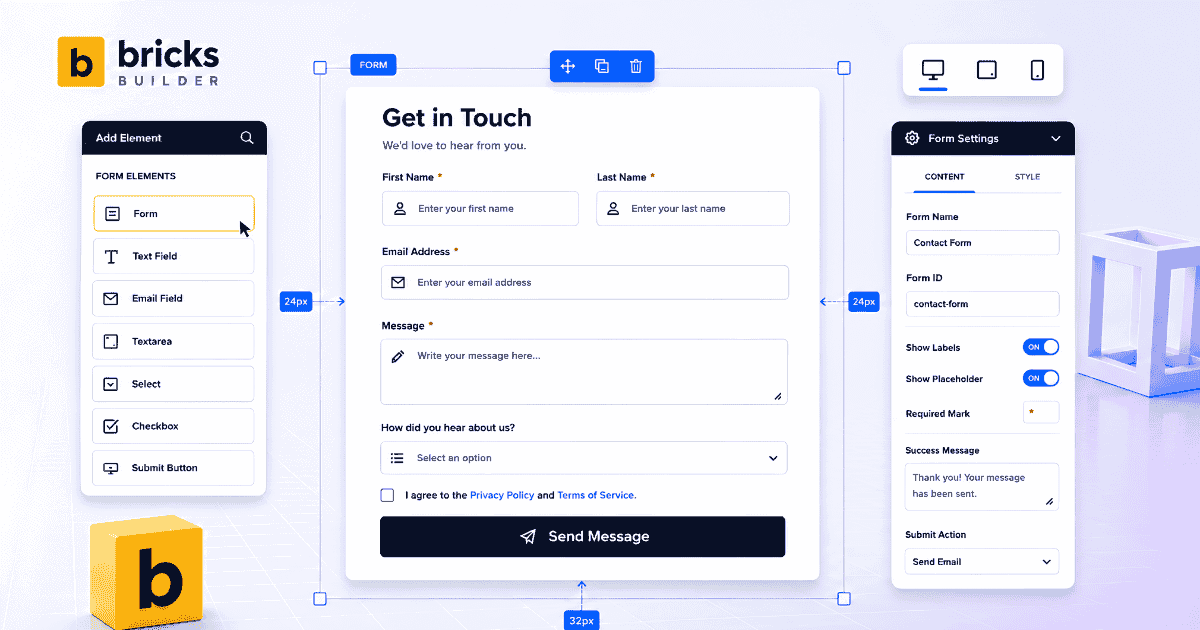
Bricks Builder includes a native Form element that handles everything a contact or lead capture form needs field configuration, email notifications, redirects, native submission storage, spam protection, and third-party integrations, all from within the Bricks editor without a separate form plugin.
This guide covers the complete Form element setup from adding it to a page through to configuring every available action, enabling spam protection, and making sure every submission is reliably captured. The final section covers what Form Vibes adds on top of Bricks’ native submission storage for sites that need more than basic entry viewing.
Before You Start
Bricks Builder theme installed and active on your WordPress site
A page already created to add the form to
Form Vibes installed and active
Adding the Form Element to a Page
Open any page in the Bricks editor by clicking Edit with Bricks from the WordPress page list. In the elements panel on the left, search for “Form” and click or drag the Form element onto your canvas.
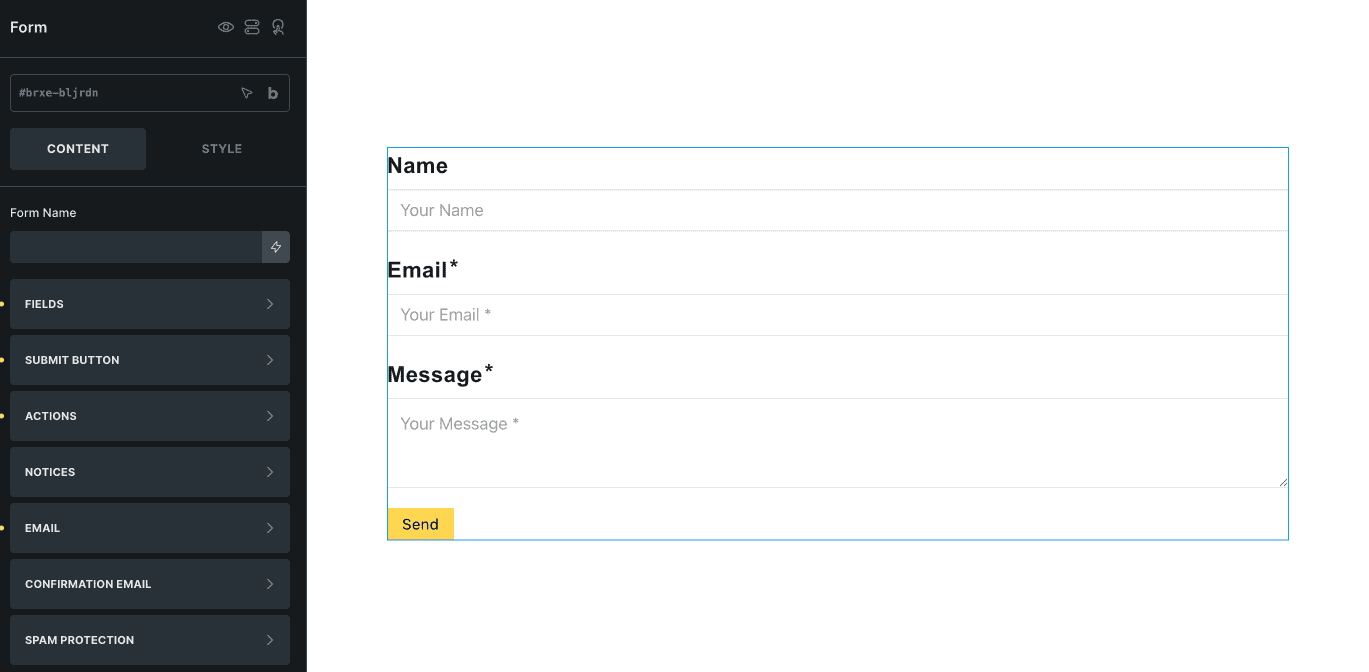
Bricks places a default form with three fields, Name, Email, and Message, and a Submit button. This is your starting point. All further configuration happens in the Content and Style tabs on the left panel while the Form element is selected.
Configuring Form Fields
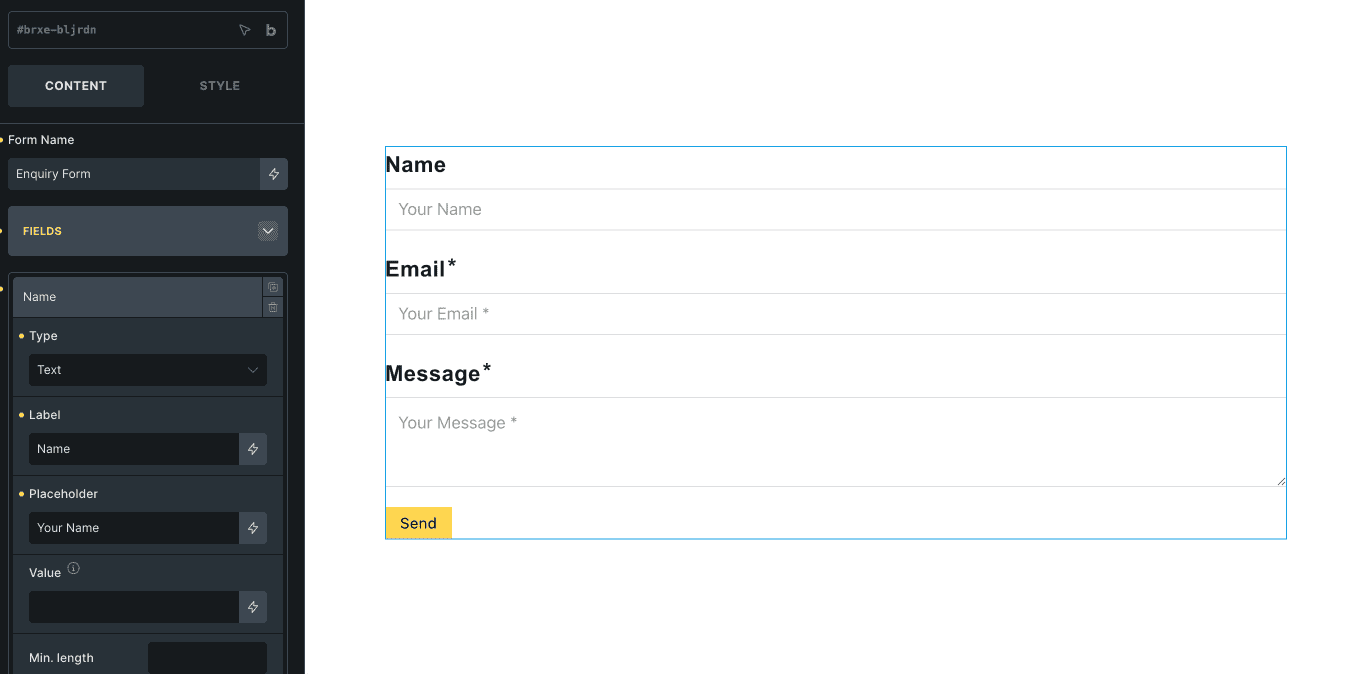
Select the Form element and navigate to the Content tab. First, add the form name, then go to the Fields section, where all the current form fields will be listed. You can access and customize each field’s settings by clicking on it individually.
The Bricks Form element supports these field types: Text, Email, Textarea, Select, Checkbox, Radio, Number, Date, File Upload, Hidden, and Password. Click Add Field at the bottom of the Fields list to add a new field, then set its type from the dropdown.
For each field you can configure the following:
Label – the visible text shown above the field on the frontend.
Placeholder – the greyed hint text inside the field before the user types.
Required – toggle this on to prevent form submission if the field is left empty. Bricks displays a validation message for any unfilled required field.
Width – controls how wide the field appears. Set to a percentage to place fields side by side. Two fields at 50% width each appear on the same row.
ID – a unique identifier auto-generated by Bricks for each field. This ID is used in email content and cannot be modified manually.
Tips: Always mark your Email field as Required. A submission without an email address has no reply path — the lead reaches you but you cannot respond.
Styling the Form and Submit Button
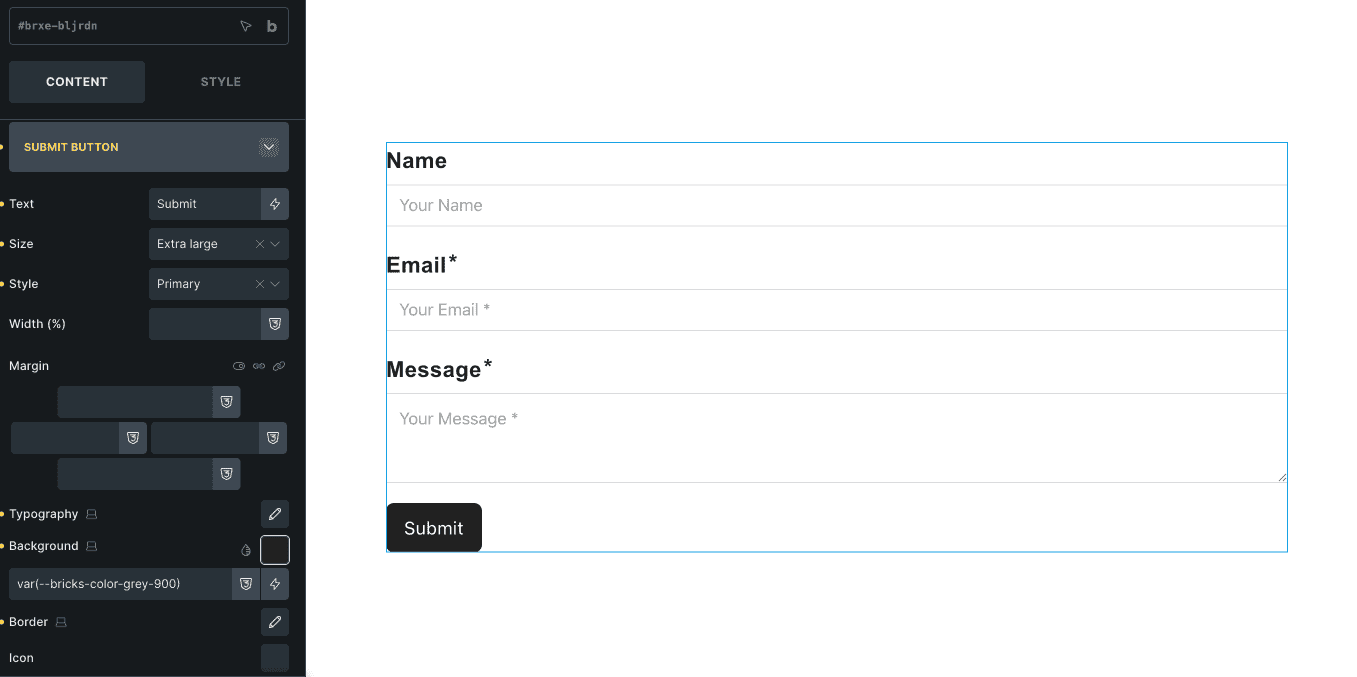
With the Form element selected, click the Style tab. Bricks gives you separate styling controls for the form fields and the submit button.
Under Fields, set the background colour, border style, border radius, padding, and typography for all form inputs simultaneously. Typography settings here apply globally to every field in the form.
Under Button, set the button text, choose from preset size and style options, or build a completely custom button design using the padding, colour, border, and typography controls. Hover state styling is also available for the button.
Your form setup is ready, but managing submissions is just as important. Form Vibes adds analytics, filtering, exports, and workflow features in Bricks form submissions without requiring any changes to your existing setup.
Configuring Actions After Submission
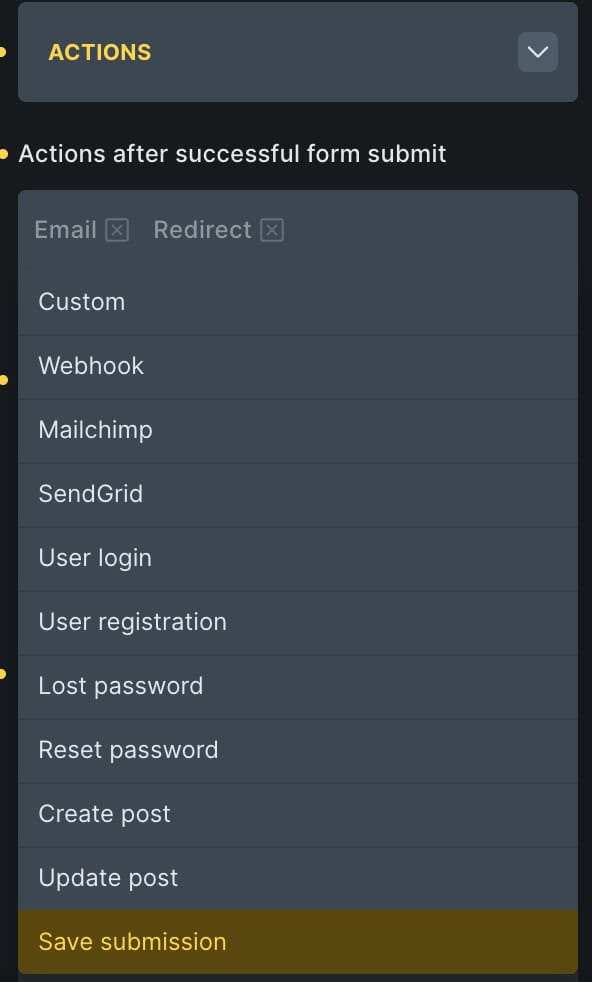
The Actions section in the Content tab controls what happens when a visitor hits Submit. Multiple actions can be stacked on the same form for example, sending an email notification, saving the submission to the database, and redirecting the user to a thank-you page can all happen from the same submission.
Click Add Action to choose from the available options.
The Email Action
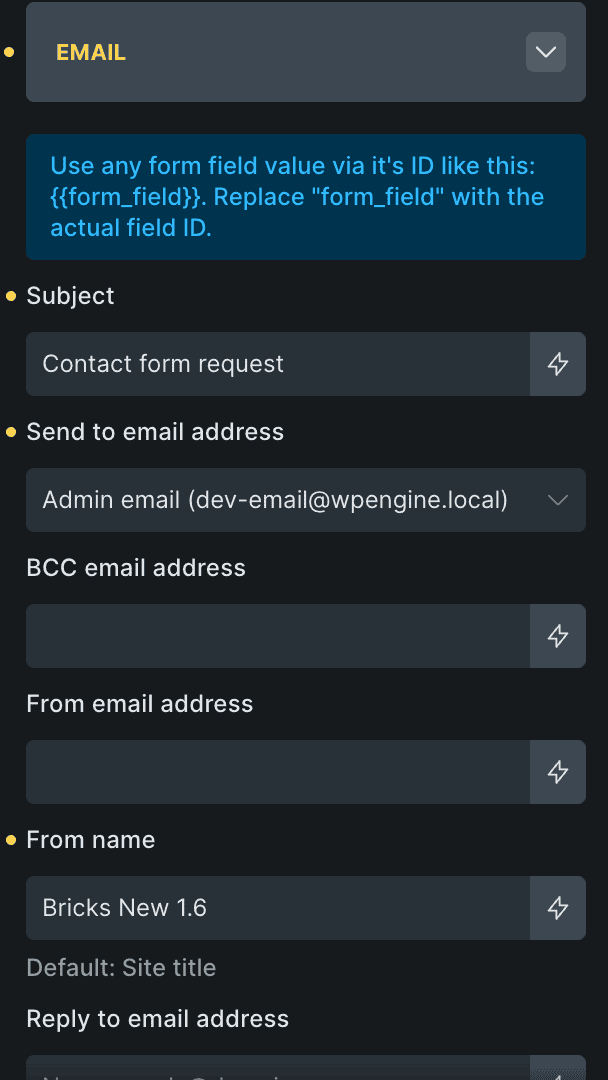
The Email action sends a notification to your team when a form is submitted. Configure it with these settings:
Subject – the subject line for the notification email. Use field IDs wrapped in curly braces to pull submitted values into the subject dynamically.
Send to email address – the address or addresses where the notification is sent. Separate multiple addresses with commas to notify several team members at once.
From email address – the sender address shown on the notification. Use a domain-matching address to avoid server rejection.
From name – the name shown as the sender in the email client.
Reply-To email address – set this to the field ID of your Email form field. When configured correctly, clicking Reply in your email client sends your response directly to the person who submitted the form rather than back to your own notification address. This is one of the most commonly missed settings in Bricks form email configuration.
Email content – the body of the notification email. Reference field IDs to include submitted values.
HTML email – toggle on to send the email formatted as HTML rather than plain text.
The Save Submission Action
Bricks includes a native Save Submission action that stores form entries directly in the WordPress database. Add the Save Submission action and give the form a descriptive name in the Form Name field, this name identifies the form in the Bricks submission viewer.
Once the action is added and the form is saved, every submission is stored in a custom database table. View entries at Bricks > Form Submissions in your WordPress admin, grouped by the form name you assigned.
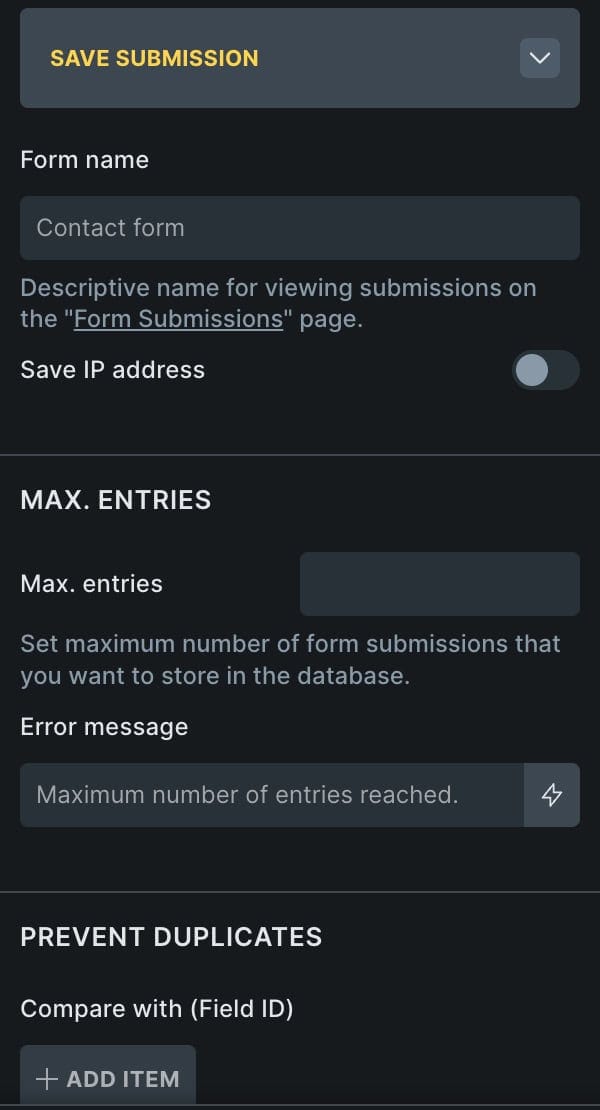
The native Bricks submission panel covers basic entry storage, deletion, and a CSV download of all entries for a form. What it does not include is analytics, date range filtering, submission status marking, an Event Log, or a unified view of Bricks entries alongside other form plugins. The Form Vibes section below covers these additions.
Important: Without the Save Submission action, submissions are sent by email only. If email delivery fails that entry is gone permanently. Always add Save Submission to every form collecting real visitor data.
The Redirect Action
The Redirect action sends the visitor to another URL after the form is submitted successfully. Set a custom URL or redirect to the WordPress admin area. The redirect only fires after all other actions in the stack have completed.
Other Available Actions
MailChimp and SendGrid integrations allow submitted data to be pushed directly to your email marketing account. Connect your API key under Bricks > Settings > Integrations first.
User Login and User Registration actions let you build login and registration forms directly in Bricks. The Login action requires a username and password field. The Registration action requires email, password, username, and name fields.
Custom allows you to hook into the bricks/form/custom_action filter and run your own code on form submission, useful for developers building bespoke submission workflows.
Enabling Spam Protection
Publicly accessible forms attract spam. The Bricks Form element includes a Spam Protection control group accessible from the Content tab while the form element is selected.
Three options are available. Google reCAPTCHA v3 runs invisibly in the background and scores submissions by likelihood of being a bot. hCaptcha shows a visible challenge to users flagged as potential bots. Cloudflare Turnstile provides a lightweight alternative challenge. All three require API keys entered under Bricks > Settings > API Keys before they can be enabled on a form.
Enable at least one spam protection method on any form collecting real visitor data. An unprotected form will accumulate spam submissions quickly, especially on sites with meaningful traffic.
Tips: Enable at least one spam protection method on any form collecting real visitor data. An unprotected form on a site with meaningful traffic will accumulate spam submissions quickly and cleaning them out manually is time-consuming and clutters your data.
What Does Form Vibes Add for Bricks Builder Forms?
Bricks’ native Save Submission action is a solid starting point, entries are stored automatically and viewable from the dashboard. For sites that need more than basic storage, Form Vibes adds a full management layer on top.
With Form Vibes active alongside Bricks, every Bricks form submission is captured to the Form Vibes database and available at Form Vibes > Submissions. From there you get date range filtering, analytics charts showing submission trends over time, a WordPress admin dashboard widget, an Event Log tracking every change to every entry, and CSV export from the Form Vibes toolbar.
Notes: Form Vibes captures Bricks submissions independently of the native Save Submission action. Even if that action is not configured, Form Vibes still stores every entry as long as the Form Vibes install and activate on the website.
| Feature | Bricks | Form Vibes |
|---|---|---|
| View entries in dashboard | Yes | Yes |
| Date range filtering | No | Yes |
| Analytics & reports | No | Yes |
| CSV export | Yes | Yes |
| Inline entry editing | No | Yes |
| Notes per submission | No | Yes |
| Google Sheets sync | No | Yes |
| Role-based access manager | No | Yes |
| Event Log | No | Yes |
Form Vibes Pro adds advanced field-level filtering, submission status marking (Read, Unread, Spam), inline entry editing, submission notes for team annotations, Export Profiles for saved reusable exports, Google Sheets sync, and a Role Manager for team access control.
One important note for the setup: Form Vibes identifies Bricks forms using a Form Name that you add to the Bricks form element. This is unique to Bricks and takes two minutes to add. The complete step-by-step setup guide is at How to Save Bricks Builder Form Submissions in WordPress.

Key Takeaway:
If you only use Bricks on your site, Form Vibes adds the analytics and filtering layer that the native panel lacks. If you also run other form plugins alongside Bricks, Form Vibes becomes the single place to manage everything.
Conclusion
The Bricks Builder Form element covers the full range of contact and lead capture form requirements, flexible field configuration, email notifications, native submission storage, redirect handling, spam protection, and third-party integrations, all without a separate form plugin.
For analytics, team-based submission review workflows, advanced filtering, and managing Bricks forms alongside other plugins on the same site, Form Vibes adds the management layer that the native panel does not provide.
Ready to set up Form Vibes with your Bricks Builder forms? See the complete guide on how to save Bricks Builder form submissions in WordPress.

Get more out of every Bricks Builder submission
Bricks stores the entries. Form Vibes tells you how many, when they came in, and helps your team act on them with filtering, analytics, and an audit trail the native panel doesn’t have.
Frequently Asked Questions
Common questions about configuring Bricks Builder form submissions.
Does Bricks Builder include a native form element?
Yes. The Bricks Builder Form element is built into Bricks and available without any additional plugin. It supports multiple field types, email notifications, redirects, native submission storage, spam protection via reCAPTCHA, hCaptcha, or Cloudflare Turnstile, and third-party integrations including MailChimp and SendGrid.
What field types are available in the Bricks Builder Form element?
The Bricks Form element supports Text, Email, Textarea, Select, Checkbox, Radio, Number, Date, File Upload, Hidden, and Password field types. Each field has individual settings for label, placeholder, required toggle, and width.
Does Bricks Builder save form submissions natively?
Yes, add the Save Submission action to your form, give the form a name, and Bricks stores every entry in a custom database table. Submissions are viewable at Bricks > Form Submissions and can be downloaded as a CSV.
What is the difference between the Bricks Save Submission action and Form Vibes?
The Bricks Save Submission action stores entries in a custom database table and makes them viewable from the Bricks admin panel with basic deletion and CSV download. Form Vibes adds analytics charts, date range filtering, an Event Log for deletion and edit tracking, a dashboard widget, advanced field-level filtering (Pro), submission status marking (Pro), and a unified dashboard covering all nine supported form plugins in one place alongside Bricks.




Leave a Reply